Showing posts with label beneficial insects. Show all posts

Friday, February 23, 2018

Questions from the Master Gardener Hot Line: Nematodes to the Rescue!

Nature's Way to Control Beetles and Grubs
by Pat Vance
Volunteers for the Philadelphia Master Gardener Hot Line have researched and answered some interesting questions. From time to time, we'd like to share some of those with you.
Photo: Philadelphia Master Gardeners

If you have a question about gardening, call us at 215 314 8711 or send an email to philadelphiamg@psu.edu

Photo: PSU Extension
Beetle and Grub Infestation:
His pepper plants did great for several years, but during the last three years, they have suffered from beetle infestation. He begins to see grubs, the larval stage, starting in June. By the end of the month, the beetles are swarming. They devour blossoms and chew through the petioles of the leaves, leaving behind a ragged sorry-looking stem with dead leaves scattered on the ground. When the beetles disappear in another month, the plants recover. But his crop of peppers is diminishing with each season. He doesn't want to use pesticides. Is there another option?


Photo: PSU Extension
Cultural Practices: 
He can till the soil in the spring to remove the grubs, and he can rotate plant positions every year.  

Turning over the soil has advantages in a few ways, but it can also increase annual weed growth. It is also tedious and may not be completely successful for removing all the grubs.


Photo: OR State Univ Extension Master Gardener
Rotation of crops is always a good idea for many reasons. In this case, the beetles don't bother the tomatoes or leafy greens. They go straight for the peppers.

In a large garden, moving the peppers from year to year can help. However, this man has a small garden. Flying beetles won't have any trouble locating plants that are now only a few feet from last year's site.


Biological Control: 
Photo: PSU Extension
Nematodes to the rescue! Nematodes are tiny, clear worms that occur naturally in nearly every ecological niche on earth. There are thousands of kinds of nematodes found in soil, and fresh or salt water from the hottest to the coldest climates, including mountains, deserts, and deep ocean trenches. Most of them are tubular, tapered at each end, and cannot be seen with the naked eye.


 There are a few nematodes that can cause damage to plants, but the ones of particular interest to gardeners are parasitic nematodes, often simply called beneficial nematodes.

Photo: PSU Extension
Beneficial nematodes kill the larvae of many species by piercing and entering them, and then secreting toxic bacteria.
Photo: PSU Extension
The nematode divides inside the dead grub. Then the progeny move on through the soil, using differences in heat and CO2 to find more grubs. Many kinds of soil-dwelling pests can be controlled this way, including beetles such as Japanese and Green June beetles, maggots, fleas, and several kinds of weevils and borers. They are useful for infestations of grubs on lawns as well as in garden beds.

Here is a link to an article on beneficial nematodes from Penn State Extension
http://ento.psu.edu/extension/factsheets/parasitic-nematodes

Photo: Arbico
The nematodes should be applied when the grubs are growing in the soil. For many insects, that's in the spring, but be sure to identify your garden pest carefully and understand the timing of its life cycle.

A few million nematodes can be applied to a 1000 square-foot garden and successfully contain pest infestations. One application may be enough, but in some cases, the nematodes must be re-applied for a couple of years.

You can buy beneficial nematodes from a few sources. Here are links to a few:
Gardens Alive!: https://www.gardensalive.com/article1101
Buglogical: https://www.buglogical.com/beneficial-nematodes/
Arbico Organics: https://www.arbico-organics.com/category/beneficial-nematodes

Arbico has a very good FAQ page on beneficial nematodes:
https://www.arbico-organics.com/category/beneficial-nematodes-faqs

Application:
The nematodes may arrive suspended in a liquid or gel, on a sponge, or in moist granules. They are added to water, gently stirred to break apart any clumps, and allowed to soak for a short time. The exact procedure will be explained in the product insert.
Photo: City of Tillamook, OR
The slurry is then sprinkled on the garden. This can be done with anything from a watering can to commercial sprayers. They will settle to the bottom of the can or bucket, so the water should be stirred frequently during the application. They will clog fine filters and meshes, so it's best to leave those off. Remember that nematodes are living organisms and should be handled gently.

Nematodes need moisture, so the soil should be watered well before application and then lightly afterward. Late afternoon is ideal to avoid the hottest temperatures of the day until the nematodes have established themselves in the ground.

For more information, here are a couple of additional links:
UMass Amherst: https://ag.umass.edu/landscape/fact-sheets/beneficial-nematodes
UMD extension: https://extension.umd.edu/hgic/nematodes

Using parasitic nematodes is a safe, sustainable, and easy way to manage garden pests that live in the soil.
Photo: PSU Extension

If you have any other questions and are not sure where to turn, ask the Hot Line! If we don't know the answer, we know someone who does!

Thursday, May 22, 2014

Late Spring Tasks for the Vegetable Garden

Sherrilyn M. Billger

All vegetable gardeners want a successful harvest, and I’ve found that no time is more pivotal than the first month or so after planting. This is when our seedlings take route, and establish a strong foundation for future growth. I spend more time in my garden in spring than any other time of year, and it always pays off. Here’s a list of late spring tasks that will benefit your organic vegetable crops.


1. Attract pollinators

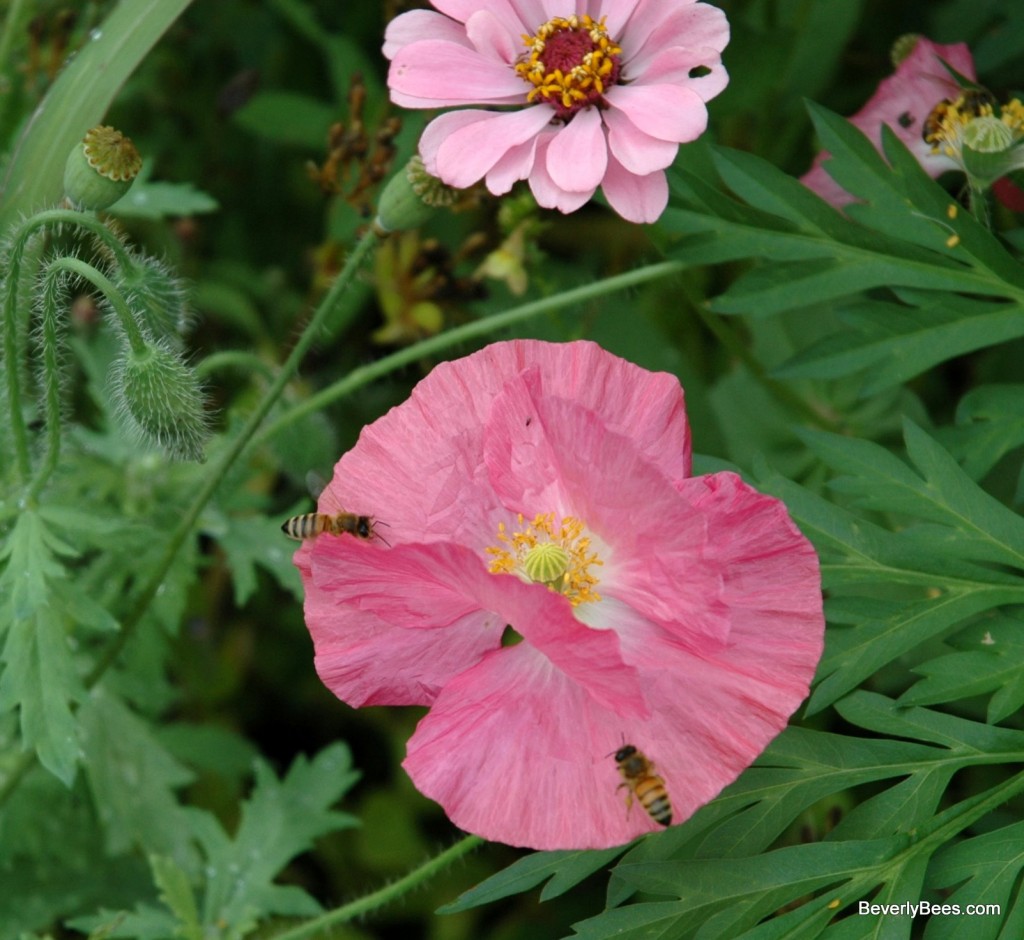
Many of our vegetable plants already attract bees and butterflies, but we can supplement these with flowers like Echinacea, bee balm (Monarda), poppies, zinnias, yarrow, and sunflowers, among others.  And I like to grow common milkweed (Asclepias syriaca) to attrach Monarch butterflies, and bronze fennel to attract Swallowtails. It’s also a good idea to include a shallow water source for the pollinators. And if you’re committed to attracting pollinators, you could get your garden certified.

2. Protect your vegetables from critters

I live in central city Philadelphia, but my vegetable garden lives in rural Berks county (zone 6b). I see no deer or groundhogs in my neighborhood, but they certainly frequent the neighborhood around my garden. The local rabbits are quite voracious as well. So I’ve installed simple 8-foot long 2x4 posts (not pressure-treated) and plastic deer fencing. I added heavy logs around the perimeter to prevent the rabbits and groundhogs from sneaking under the deer fence. I’ll have to keep an eye on my fence throughout the growing season, because those critters are crafty, and just might find/dig/gnaw a way through or around my fence. Vigilance is key.

3. Weed and Mulch

As they establish themselves, our vegetable plants compete with weeds for sun and water and soil nutrients. My garden is host to a seemingly endless army of thistles and wild onions. Until my vegetables are large enough to shade competitors, I need to weed frequently. I also use mulch to keep the soil moist and discourage weeds. Some gardeners use inorganic materials, but I prefer organic mulch. It doesn’t keep every weed out, but it will slowly decompose and further nourish my soil.

You might consider red plastic mulch for your tomatoes. Penn State scientists found that red mulch increased tomato harvest by 10 percent, on average.  To keep the weeds at bay and encourage a better tomato harvest, staple red mulch to black mulch and lay it on the ground red side up. The easiest time to do this is before you plant your seedlings, but you could also lay it after planting, and create cut-outs for your tomatoes to poke through.

4. Erect plant supports

If you haven’t yet done so, now is a great time to install plant supports.  Putting off this task will leave you wrestling with large plants, and you’ll risk breaking the stems and damaging the roots. Supports are particularly important for peas, pole beans, and tomatoes. I also like to provide supports for my cucumbers, and occasionally for my pepper plants. Garden supply stores offer a wide variety of stakes, teepees, and cages, but you can also make your own. In order to keep your garden chemical-free with natural materials, choose bamboo, cedar, cypress, and jute twine. I use jute twine throughout my garden, because I can toss it in my compost pile in the fall.

There are many ways to support your tomatoes. As a beginner gardener, I used the ubiquitous metal cages, but now I’ve graduated to the Florida weave.  It is a simple method, and requires stakes and twine. If your garden is in a windy area, put stakes between each plant and at the end of the rows. Use fewer stakes if wind isn’t such an issue for you. Begin your first weave about 6 inches from the ground, securing the twine to one end and gently weaving the twine through the row, next to each plant. After you get to the end of the row, finish the weave back to the end where you started and tie it off.  Add a new row of twine every week or so. (Side note: I grow indeterminate heirlooms, so I plan to prune my tomato plants throughout the season. Even with the Florida weave, the plants will get too tall eventually.)

5. Make frequent inspections

Organic vegetable gardening is actually really easy. The biggest time commitment comes in the spring, but the summer and fall payoff is truly worth it. Take a little extra time now to nurture the plants and help them set a strong foundation. The absolute best thing you can do for your garden now and throughout the growing season is to walk around and look at the plants. How are they doing? Are they getting enough sun and water? Do you see any evidence of disease or insect damage? Catch it early, and your plants are likely to recover. If you find something strange or troubling in your garden, don’t hesitate to contact the Master Gardeners. We’re here to help!


Thursday, August 8, 2013

Yellowjackets - Love 'em or hate 'em

By Sandy Grimwade

Recently I was admiring a beautiful apricot tree in Center City loaded with soft orange apricots, but the apricots were swarming with yellowjackets. Gardeners have a love/hate relationship with yellowjackets -- they are know for their beneficial predation on many harmful insect species and their nasty habit of getting aggressive if disturbed.

What are yellowjackets and how should we, as gardeners, take advantage of their good side and avoid their dark side?

German yellowjacket (Vespula germanica)
Yellowjackets are social wasps that live in colonies of males, workers and queens -- very similar to the social arrangements of honey bees to which they are distantly related. Only the queens overwinter, and when they emerge in the spring, they establish a new colony in a small paper nest which she builds. Soon the colony starts to grow rapidly, and by the end of summer may contain 4,000 to 5,000 wasps. This is why yellowjackets become so common in late summer, and also the reason why they become more aggressive, especially as food shortages start to occur in the fall. Then yellowjackets start showing up at outdoor picnics, on garbage cans, and on fallen fruit.

There are several species of social wasps that are commonly called yellowjackets. The common wasp and the German wasp are European species that are now fully established in North America.The eastern and western yellowjacket and several others are native species. They all look quite similar and have similar habits.  The German yellowjacket especially is a recent and aggressive invader, and is overtaking the eastern yellowjacket as the dominant species in this area.

Eastern yellowjacket (Vespula maculifrons)
Yellowjackets are very beneficial insects -- they are mostly insectivorous and they feed on the larvae of blowflies, houseflies, beetles and many insects that harm ornamental and edible plants. Unless a nest is located in an inconvenient location, we should leave them alone and let them get on with helping to keep the garden free of harmful insects.

As everyone knows, yellowjackets can become aggressive if they or their nests are disturbed. They prefer not to sting but will do so if provoked.

A yellowjacket sting is unpleasant for most people and can be serious for those who are allergic. So, don't look for trouble. Don't go near suspected nests, and don't flap your arms if they start coming close. If yellowjackets become aggressive and start making trouble when you are in the garden, you may need to resort to spraying the colony. This should be a last resort in our relationship with these social and beneficial insects.

Thursday, June 21, 2012

Beneficial Insects and flowers in the vegetable garden.


Always on the quest to improve my garden and learn more about "organic" methods to prevent insects from devouring my plants, I recently searched for flowers to intertwine with my vegetable garden to increase beneficial insects.

After reading and finding lists, I found many of the suggested plants are already growing in my garden. A pleasant surprise to say the least.  I have in the past planted basil, sage, bronze fennel, dill and parsley without thinking about insects. The herbs were planted to eat not deter insects. A neighbor told me to plant marigolds to control aphids around the tomatoes. I found the marigolds did indeed keep the aphids down so I interplanted them again this year. 

The parsley and dill draws a beautiful black swallowtail butterfly every year so I plant parsley and dill just for them. When I see the yellow striped catepillar I know the plants will be soon deleafed and the caterpillars gone to come back as a beautiful butterfly.. 

Below is a partial list of plants suggested for drawing beneficial insects to the gardens and those I have planted. 


Annual Flowers and Herbs  

Basil (Ocimum basilicum) -- The flowers attract bees and other beneficial insects. A few sites offered the aroma of the leaves may deter aphids.

Calendula (Pot Marigold) -- Edible, orange or yellow flower petals.  Attracts bees, butterflies and hoverflies.

Cosmos -- Attracts lacewings, hoverflies and parasitic mini-wasps. 

Dill (Anethum graveolens) -- The leaves are used in recipes, and the flowers attract lacewings, ladybugs, hoverflies and parasitic mini-wasps.  The black swallowtail butterfly also enjoys this herb in my garden.

Marigold (Tagetes sp.) -- The flowers attract butterflies and hoverflies, and the roots produce a secretion that kills root-eating nematodes in the soil. 

Parsley (Petroselinum crispum) -- The flowers attract hoverflies, tachinid flies and parasitic wasps. 

Zinnia (Zinnia elegans) -- A wonderful flower for attracting, hoverflies, parasitic wasps and butterflies.  


Perennial Flowers and Herbs

Photo by Bruce Marlin NW Center for alternative pesticides 
Bronze Fennel  (Foeniculum vulgare 'Purpureum') --Bronze foliage. The flowers attract lacewings, ladybugs, hoverflies, parasitic mini-wasps and butterflies.

Chives (Allium schoenoprasum) -- Attracts butterflies and bees. Seeds will self sow all over the garden, deadhead religiously.

Garlic Chives  (Allium tuberosum) -- The flowers attract bees and beneficial insects. The leaves have a nice, strong garlic flavor. Reading information on this herb I found it repels aphids on roses. 

Lemon Balm  (Melissa officinalis) --  The tiny flowers attract hoverflies, tachinid flies and parasitic mini-wasps.  The leaves make a nice lemon flavored tea.

Sage  (Salvia sp.) -- There are many forms of sage, including culinary. They all attract bees and butterflies. Culinary sage is used with pork, and the leaves can be fried.

Yarrow (Achillia sp.) -- Attracts ladybugs, hoverflies and parasitic mini-wasps. A favorite in my garden that doesn't need alot of water.


For more information on insects, check out the Penn State Entomology site:

Another Extension site worth visiting on this issue is http://umaine.edu/publications/7150e/

Additional Information http://www.motherearthnews.com